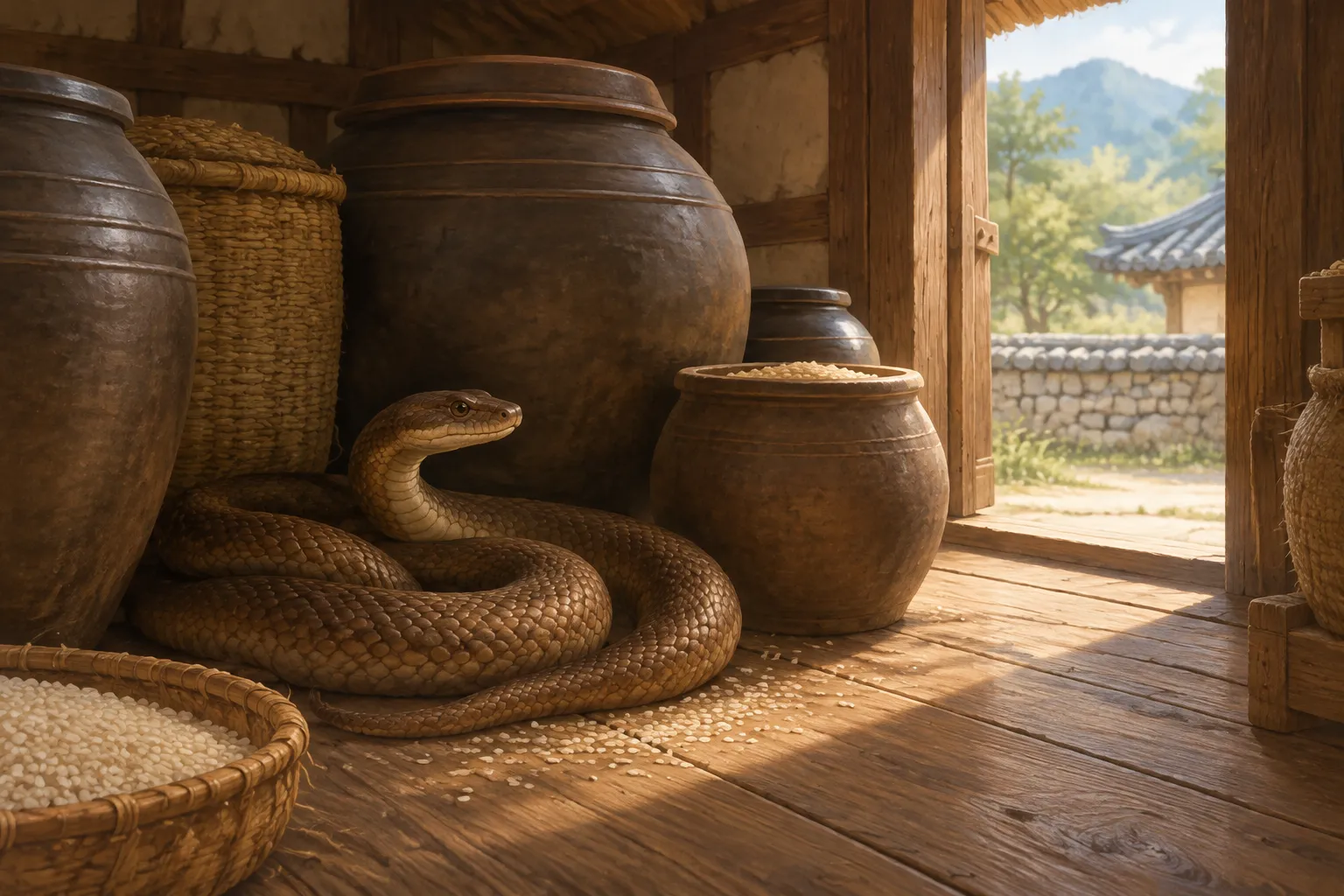
A snake slipping through a storehouse might seem like something to drive away. In Korean household belief, however, removing the wrong snake could mean losing the household’s fortune. Eop, a guardian associated with material prosperity, was commonly represented by a snake; its departure could foretell the family’s ruin. The Encyclopedia of Korean Culture’s entry on Eop records this unsettling possibility: wealth was not simply something a family possessed. Its supernatural protector might choose to leave.
That belief offers a different kind of encounter with Korean mythology. There is no king to rescue and no monster to defeat. The important question is how to live alongside a presence that helps sustain the home. Read through an eighteenth-century literary witness and later accounts of domestic practice, Eop becomes a way to explore the fragile relationship between shelter, food, and good fortune.
A Guardian Without One Fixed Shape
Eop belongs to the world of gasin, household deities. Choe Gil-seong’s specialist encyclopedia account identifies it as a deity governing the fortunes of household wealth. A snake is its most representative animal, but weasels and toads also occur, and some accounts allow human forms. Material representations vary too: a jar containing rice or a structure woven from straw could serve in its veneration.
These alternatives matter. Calling Eop simply a snake god makes a memorable introduction, but it leaves out the distinction between a divine function and one way that function becomes visible. The household’s prosperity is the connecting thread; the animal or object is not identical in every account.
We should therefore resist assembling all the recorded possibilities into one imaginary shrine. A rice jar, a straw structure, and a resident animal need not belong to the same family’s practice. The evidence is better approached as a set of related ways of recognizing a protective presence, rather than instructions for a single nationwide ritual.
Even the name requires caution. The encyclopedia treats Eop’s etymology as unresolved. Writing it with the character 業 does not, by itself, establish a secure origin or justify turning this Korean household deity into a straightforward embodiment of Buddhist karma.
The Storehouse Snake in an Eighteenth-Century Account
A particularly vivid witness appears in the writings of Yi Deok-mu, an eighteenth-century Joseon scholar. A Korea Heritage Agency article on snake symbolism reproduces a passage attributed to his collected works, Cheongjanggwan jeonseo. It describes reports of snakes or weasels inhabiting wealthy families’ storehouses, receiving white porridge, and being treated as divine beings. Their departure is linked to the household’s downfall.
The attribution gives the subject a historical foothold. Eop is not merely a creature reconstructed from recent entertainment or an anonymous internet list. Here, a named Joseon writer records a connection between stored provisions, an animal presence, and prosperity.
Nevertheless, this remains a literary report of belief, accessed here through the heritage agency’s reproduction rather than an independently consulted edition of Yi’s complete text. It does not tell us how often the custom occurred, how every participant understood it, or whether one household’s practice matched another’s.
The porridge is especially suggestive. As an interpretation, the offering makes prosperity look reciprocal: the household feeds the being associated with its abundance. The relationship is not expressed through conquest. The striking action is hospitality toward something that might otherwise be unwelcome.
Small Offerings, Different Ritual Calendars
Later descriptions bring Eop into the rhythm of household observance. The heritage agency’s account of domestic snake veneration describes women offering rice and vegetables at Jeongwol Daeboreum, the first full moon of the lunar year, while praying for successful farming and an expanding livelihood. It also mentions regional observances on the ninth day of the ninth lunar month, at the winter solstice, or on another festival.
Choe’s Eop entry, by contrast, emphasizes offerings during household gosa rather than a distinctive ceremony belonging exclusively to the deity. These descriptions should remain distinguishable. One emphasizes calendrical examples; the other presents Eop within broader household worship. Neither warrants assigning every Korean family the same annual schedule.
For a reader, the useful lesson is methodological as much as mythological. A custom described in one summary is not automatically a rule for an entire country. Household religion is particularly vulnerable to that mistake because its modest acts can look deceptively interchangeable.
An offering of everyday food also invites a quieter reading of religious experience. The gesture need not be spectacular to carry weight. If the desired blessing is enough food, a secure home, and a viable livelihood, then a small meal offered within that home can be understood as proportionate to the concern—not evidence that the concern was unimportant.
Eop Within the Household’s Sacred Geography
Eop is easier to understand within the wider category of household belief. Jang Ju-geun’s encyclopedia survey of gasin sinang distinguishes these practices from formal Confucian ancestral rites, while acknowledging their overlap with shamanic and village religion. Women commonly maintained domestic observances, often through modest offerings drawn from food prepared for family occasions and festivals.
This context prevents two opposite errors. Eop should not be detached from religious practice and reduced to a decorative lucky animal. Nor should every domestic offering be imagined as a large shamanic performance. The survey describes a religious life whose scale could be intimate and whose boundaries were not always rigid.
The contrast with jangseung as protective guardians offers a useful change of perspective within Korean folklore. Here the focus moves inward, from a conspicuous guardian figure to a presence that might remain unseen. This is a comparison of protective settings, not a claim that the two traditions share one origin.
As an interpretive image, Eop makes the storehouse more than a container for possessions. It becomes a place where practical security and sacred responsibility meet. The question is no longer only how much a family has accumulated, but whether the conditions sustaining that abundance will endure.
What It Means When Fortune Can Leave
The departure motif is the belief’s sharpest edge. In Choe’s description of Eop leaving the house, ritual impurity can prompt the deity’s exit, with ruin following. This is a statement about what people believed, not evidence that an animal’s movement caused financial disaster.
One possible reading is that Eop gives uncertainty a recognizable shape. A household cannot make prosperity permanent merely by wishing for it. Imagining its guardian as a living presence expresses that insecurity with unusual force: good fortune has not become a lifeless possession under complete human control.
There are also limits to the historical picture. Jang’s survey of household religion warns that traditions surrounding Eop and other domestic deities were disappearing before they had been adequately collected. Its account should not be treated as a present-day census, or expanded into a claim that all Korean households once maintained identical beliefs.
What survives is compelling without those exaggerations. In these accounts, the creature a householder might fear could also be the presence the household most dreaded losing. Eop asks readers to reconsider the boundary between an intruder and a guardian—and to imagine prosperity not as a treasure won once, but as a relationship requiring care.
Sources and Further Reading
- Choe Gil-seong, “Eop”, Encyclopedia of Korean Culture, Academy of Korean Studies. Definition, manifestations, offerings, and departure beliefs.
- Jang Ju-geun, “Household Deity Beliefs”, Encyclopedia of Korean Culture, Academy of Korean Studies. Domestic religious context and limitations of the surviving record.
- Korea Heritage Agency, “2013년 01월 – 문화상품 소개 뱀자석세트”. A cultural-product feature containing a discussion of Eop, a passage attributed to Yi Deok-mu, and examples of seasonal offerings.
